

7 Ways AI Moved the Starting Line for Car Dealers
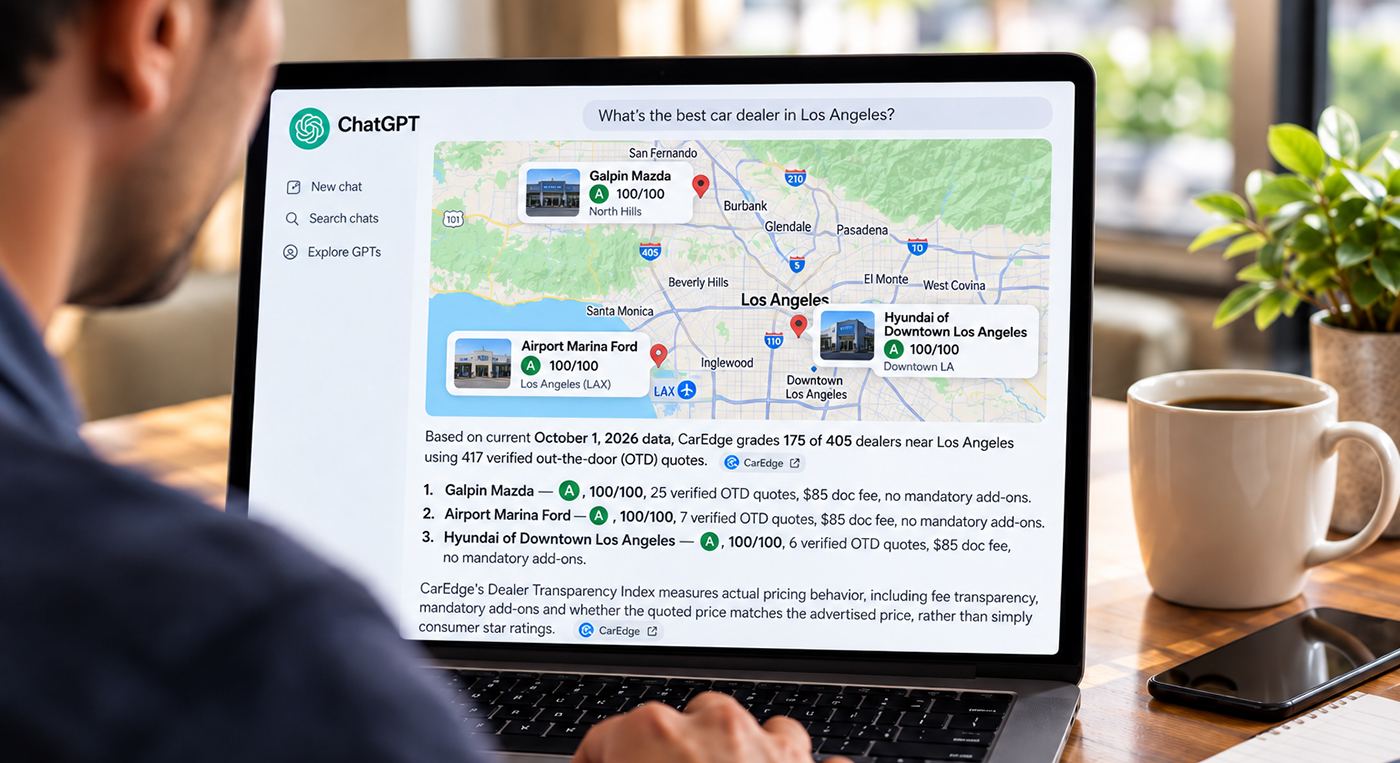
A shopper asks an AI assistant for the “best Toyota dealer near me.” Before that shopper visits a dealer website, opens a vehicle detail page or submits a lead, the system can return a short list and explain why those stores made it. That changes the sequence dealers have spent years optimizing.
The old starting line was search. Then came the website visit, the form fill, the CRM record and the follow-up. AI can move meaningful parts of comparison and selection ahead of all four. By the time a lead appears, the shopper may already have compared stores, pricing practices and reputation signals.
Dealer operators should treat this as an operating issue, not a marketing experiment. The practical question is no longer whether consumers will use AI in automotive shopping. It is whether your store supplies the kind of accurate, verifiable information that an AI system can find, understand and use.
1. Audit the Answer, Not Just Your Search Ranking.
Start with a simple exercise. Ask several major AI platforms the same questions a shopper would ask: “best Ford dealer in [city],” “Toyota dealer with transparent pricing,” or “where should I buy a new RAV4 in my market?” Record which stores appear, what the answer says about them and which sources support the response. The reason is measurable.
The exact mix of sources will change. That is precisely why your need to audit it repeatedly. Appearing on the first page of Google search results does not tell you whether an AI assistant includes your store in a three-dealer answer.
2. Treat Written Pricing as Public Reputation Data.
For years, dealers could think about pricing execution and reputation management as separate disciplines. AI makes that separation harder to defend. A written out-the-door quote can become a durable datapoint. So can a mandatory protection package, a doc fee or a refusal to provide a complete price remotely.
If third parties collect and structure those facts, AI systems can potentially use them when a shopper asks where to buy. Dealers should assume that the written quote leaving the store may influence more than the customer who requested it.
3. Mystery-Shop Your Own Store Before Somebody Else Does.
Management policy and shopper experience are not always the same thing. A GM may believe add-ons are optional, the internet pricing is clear, and their BDC provides complete answers. The only useful test is what a shopper actually receives.
Run the same inquiry against your own rooftop at different times and through different channels. Ask for an itemized out-the-door price. Ask whether every add-on is optional. Check how long the response takes. Then compare that experience with nearby competitors.
This is where AI can make an old dealership discipline much more scalable. A machine can repeat the same request consistently, preserve the conversation and compare the result across rooftops. For groups, that creates a practical way to find execution gaps before those gaps become reputation data.
4. Measure the Gap Between the Advertised and Buyable Price.
A low advertised number can win attention and still lose trust if the actual transaction expands through fees and required products. More important for operators, the spread can be large enough to change which store looks competitive after a shopper gets serious.
In June, I executed an AI experiment that sent the same buyer profile to more than 100 dealers. Its Toyota RAV4 Hybrid test found a $9,221 out-the-door spread, while its Ford F-150 test found a $9,256 spread.
Those are not small differences that disappear inside a monthly payment. They are large enough to reshape a shopper’s dealer choice. Track advertised-to-OTD variance as an operating metric. Do it by salesperson, channel and rooftop. A dealer cannot manage AI visibility directly, but it can manage the underlying facts AI and shoppers encounter.
5. Stop Designing the Website Around the Form Fill.
A website that withholds useful information until a shopper submits name, email and phone number reflects an older funnel. AI-trained consumers increasingly expect an answer first. Your site should be able to answer the questions that determine whether a shopper stays:
- Is the vehicle actually available?
- What is the real price?
- What fees apply?
- Are add-ons mandatory?
- What does the payment look like?
- What is my trade worth?
- Can I reserve the vehicle or schedule service?
The standard should be response quality, not lead-form completion. If your digital experience cannot answer a straightforward pricing question at 10 p.m., the shopper has plenty of other places to ask it.
6. Prepare for the Lead to Arrive With More Work Already Done.
The next generation of automotive leads may look less like “John Smith wants information on Stock No. 1234” and more like a partially assembled deal. The shopper may arrive with a specific unit, financing status, trade information, price expectations and a buying window. That should change CRM routing and staff expectations.
A high-intent AI-assisted shopper should not enter the same generic cadence as someone who downloaded a brochure. Preserve the context that came with the customer. Route it to someone who can act on it. Do not force the shopper to repeat information the system already captured.
Agent-to-agent transactions make this more concrete, with AI agents now already operating on behalf of both the shopper and dealership. Whether that becomes common quickly or gradually, the operational lesson is useful now: Your systems need to receive structured intent, not merely contact information.
7. Give AI Clean Facts to Work With.
Dealers cannot control every answer an AI system produces. They can control much of the information that describes their own business. Audit your hours, addresses, inventory feeds, pricing, fee disclosures, policies and store descriptions across your website and the sources shoppers commonly encounter.
Remove contradictions. Make pricing terms explicit. Keep inventory current. If a policy matters to a buying decision, state it plainly enough that both a person and a machine can understand it. Then test again. This is the uncomfortable part of the AI shift for automotive retail.
Dealers spent years trying to get the lead faster. The more urgent job now may happen before the lead exists. If an AI assistant is helping a shopper decide which stores deserve consideration, your pricing practices, response quality and data accuracy are already part of customer acquisition.
The starting line has moved. Your operating process has to move with it. Dealers have spent years optimizing what happens after a shopper raises a hand. AI is forcing a harder look at everything that happens before that moment. The accuracy of your inventory, the clarity of your out-the-door pricing, the consistency of what your team puts in writing and the quality of the answers that shoppers receive are becoming part of how your dealership gets discovered and evaluated.
You cannot control every AI recommendation, but you can control the facts those systems encounter about your store. Dealers that audit those facts now, correct weak processes and make their value easy to verify will be better prepared for a buying process that increasingly begins before the traditional lead ever exists.
Zach Shefska is the co-founder and CEO of CarEdge.

